
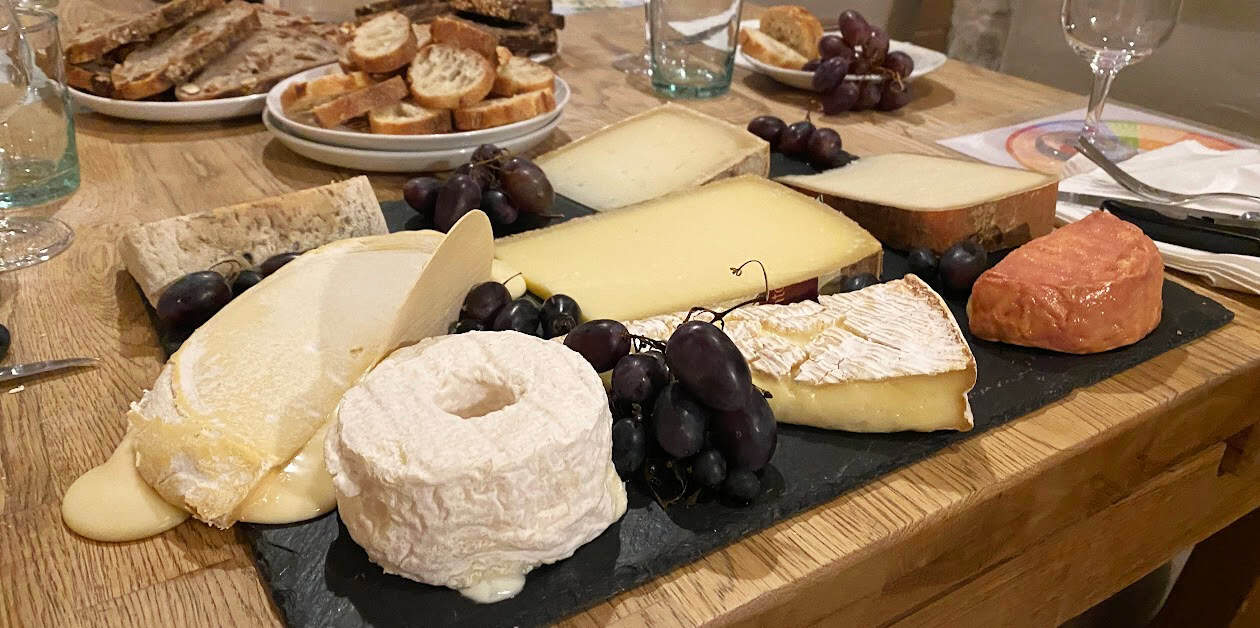
Our cheese tasting in Paris started with a steep staircase under a cheese shop in the Marais.
At the bottom was a 17th-century cellar, where a chef and sommelier named Andrés walked us through eight French cheeses and four wines.
We had landed on a red-eye that same morning. It's still one of our favorite tours of all time, and it's the reason I'm now obsessed with Comte.
Below is every cheese we tasted, the wines that came with them, and what I'd want to know before booking that the listing won't tell you.
This post may contain affiliate links. If you purchase through them, I may earn a small commission at no extra cost to you. I only recommend places and products I’ve tried myself.
In This Post
The Short Version
- Who we booked: Andrés, on Airbnb Experiences. He co-hosts with Aurélien, and the two also run private tastings through their company, WeTasteParis.
- What we got: 8 cheeses and 4 French wines in about 2 hours, at a shared table with other travelers.
- Where it meets now: the cellar under Vinosfera, a wine shop on Rue François Miron. Ours was under Fromagerie Jouannault on Rue de Bretagne.
- Group size: up to 9
- Cost: from $110 per person on Airbnb when I checked last.
- Book it if: you want to walk into every fromagerie for the rest of your trip knowing what to ask for. That's what it did for me.
Our Afternoon in the Cellar

Jouannault cheese shop in Paris, France
By 4 pm we had run through the Louvre, checked into L'Hotel Fougere in Saint-Germain for a much-needed shower, and eaten the free macarons the hotel provided. T
hen we took a 20-minute metro ride across town to the Marais.
The tasting was under Fromagerie Jouannault, a family cheese shop across from the Marche des Enfants Rouges.
Before we tasted anything, Andrés walked us through how cheese is made and showed us the chamber where the shop ages its cheeses.

The cheese cellar in the Jouannault cheese shop in Paris France
Then our small group sat down family style at the long table.
Food and wine tours seem to attract well-traveled people who like to talk, and ours was no exception.
We really enjoyed getting to know everyone over the cheese and wine.
Alongside the cheese, we had slices of baguette, some grapes, and a great selection of French wines poured as we went.
Andrés has lived all over the world. He went to one of France's top culinary schools and worked in some of France's top restaurants
When we went, he had his WSET Level 3 in wine.
He now leads Champagne day trips from Paris too. I don't think he was offering them yet when we went, or he would have been a great fit for our Champagne day.
Instead, we spent a lovely afternoon on a private half-day tour with Isabelle from Aÿ Champagne Experience.
She grew up in Ay, a Grand Cru village, and took us to two family producers, Joseph Desruets and Jean Milan.
Before You Book
These are the things I'd tell you that the listing won't.
- It meets in a new cellar. The group tasting now meets at Vinosfera, a wine shop with a 16th century cellar on Rue François Miron, still in the Marais but closer to the Seine. So you're still going underground into something old. I haven't been to this one, so I can't tell you how it compares to ours.
- You'll share the table. The Airbnb version is a group of up to nine strangers. For us, that was a plus. If you'd prefer your own table, book the private version.
- You're tasting, not making or cooking. Our croissant class at Maison Fleuret the next morning was the opposite. Two and a half hours with our hands in flour. If you want to make something, book that one. If you want to learn what to order, book this.
- It's a good way to beat the heat. Underground cellars like these stay much cooler than the street, so this is a smart pick for a hot summer afternoon in Paris.
- You'll get the cheese list afterward. Andrés emailed us notes on every cheese we tasted, so you don't need to scribble during the tasting.
The 8 Cheeses We Tasted
1. Rouelle du Tarn (Goat)

Rouelle de Tarn at Cheese Tasting in Paris
This goat's milk cheese from the Tarn (southwest France) is shaped like a big donut.
The curds are set in a ring-shaped mold, which leaves the hole in the center, and the outside is coated in ash. It was mild and milky, with a faint taste of hazelnut.
Andrés's notes: ours was one week old.
2. Ossau-Iraty AOP (Sheep)

Ossau-Iraty AOP (Sheep cheese)
Sharp, nutty, and one of my favorites of the night.
Ossau-Iraty comes from the Basque Country and Bearn in the French Pyrenees. Its AOP rules allow milk from only three local sheep breeds.
One producer, Agour, has won numerous World Cheese Awards.
Andrés's notes: the most typical age is 12 to 14 months, some versions are dusted with piment d'Espelette (the local Basque chili), and the traditional partner is black cherry jam.
3. Tomme de Chèvre & Brebis (Goat and Sheep)

Tomme de Chèvre & Brebis
A little goat, a little sheep.
I don't think I'd ever had a cheese made from two animals' milk before. The flavor was subtle, and the mix of milks was the interesting part.
Andrés's notes: from the Loire Valley, aged about four months, with a supple texture.
4. Epoisses AOP (Cow)

Enjoying Epoisses AOP at our Cheese Tasting in Paris
I first fell for Epoisses at The Inn at Little Washington, where Cameron, the cheese sommelier, works the dining room with Faira, a cow on wheels.
I've loved it ever since.
It's stinky (smelly socks or a touch of barnyard, depending on who you ask).
The flavor is salty and rich, and it lingers like a glass of well-aged wine.
The sticky, terracotta-colored rind comes from washing in a traditional French brandy, Marc de Bourgogne.
When it's ready, it's runny enough to eat with a spoon.
Andrés's notes: aged four to six weeks, with a smell that can remind you of bacon and eggs as well as socks.
Later that trip, we found another Burgundy cheese I love.
On our self-guided bike ride through Burgundy's vineyards, we picked up Délice de Pommard from Alain Hess, the Beaune cheesemonger who created it, and ate it with crackers at our picnic lunch in Meursault.
It's a creamy cow's milk cheese coated in mustard seed, which gives it a little spice.
5. Brie de Meaux AOP (Cow)

Brie de Meaux AOP
Smooth and buttery with hints of mushroom, and so soft in the middle it looked like custard.
The easiest cheese on the plate to love. This is a raw milk brie from Île-de-France, the region around Paris.
Andrés's notes: aged six to eight weeks, and the curds are moved into the mold by hand with a perforated ladle so they don't break up. This is what gives it that custard-like middle.
6. Reblochon de Savoie AOP (Cow)

Reblochon de Savoie AOP
Soft and custardy, and nuttier as it ages. It's the cheese in tartiflette, the Alpine bake of potatoes, bacon and onions, and we ate it again in Chamonix after long days of hiking.
Andrés's notes: the name comes from "reblocher," which means pinching a cow's udder a second time.
The story goes back to the 13th century, when farmers in the Thônes valley paid landowners a tax based on how much milk their cows gave.
They milked partway while the tax collector watched, then milked again after he left.
That second milking was richer in cream, and they turned it into cheese for their own families.
7. Comte AOP (Cow)

Comte AOP
This was the one that turned me into a Comte person.
Comte is made in the Jura Massif of eastern France. Every wheel ages at least four months, with no upper limit.
Ours was 30 months old: nutty, buttery, sweet and a little smoky.
Each wheel is graded out of 20 when it leaves the aging cellar.
According to the trade body, wheels scoring 14 or higher get a green band, and wheels scoring 12 to 14 get a brown band. If you see the green band at a shop, that's the higher grade.
Andrés's notes: a firm texture that melts in your mouth, and aged wheels can even taste of butterscotch or pineapple.
Comte kept showing up for the rest of our trip.
At lunch on our Authentica wine tour in Burgundy, Domaine Trapet started us with homemade Comté bread.
In Chamonix, we had it in fondue after a day on the trails.
8. Bleu d'Auvergne AOP (Cow)

Bleu d’Auvergne
The one I didn't like.
Bleu d'Auvergne is a cow's milk blue from the Auvergne, in the volcanic hills of central France.
It's usually described as milder and creamier than Roquefort, which is made from sheep's milk.
I haven't developed a taste for blue cheese yet, and this one didn't change that. It was fun to try but not for me. If you like blue, you'll probably love it.
Andrés's notes: ours came from the Cantal area, aged about four months, with flavors of wild mushrooms and cream.
Wine Pairings

Wine pairings at our cheese tasting class in Paris
The eight cheeses came with four French wines, red and white:
- Domaine Font de Courtedune Vieilles Vignes, Côtes du Rhône Villages 2019
- Domaine de Montcy "Ligère," Cheverny
- Domaine de Terra Vecchia "a Paesana," Île de Beauté
- Château de Caraguilhes Cinsault "Parcelle Le Jardin"
The cheeses and wines change with the season, so treat our lineup as an example.
Other Paris Cheese Tastings
If Andrés and Aurélien's dates are full, these three are also well reviewed:
- Paroles de Fromagers: 7 cheeses and 3 wines in a cheese cellar on Île Saint-Louis, about 90 minutes. The shortest and least expensive of the three.
- Les Caves du Louvre: 10 cheeses and 10 wines (five white, five red) in a cellar near the Louvre, about 2 hours. The biggest tasting here.
- Secret Wine Door: six wines, including a Champagne, with 6 French cheeses and bread, about 2 hours, in the 15th arrondissement.
What I'd Tell a Friend
Book it early in your trip.
We went on our first afternoon in Paris, and I spent the rest of the trip walking into cheese shops knowing what to ask for.
It also sent us looking for more.
On a later trip to Bordeaux, we did a food tour with Bordeaux in Bites that included eight more French cheeses.
Ossau-Iraty showed up again, this time aged eight months, next to a truffled goat cheese from the Indre and a Brillat-Savarin, a triple-cream from Burgundy.
We love French cheese!


0 Comments