
Top 10 South African Foods: Here’s What’s Delicious!
My husband and I spent two weeks in South Africa, and a lot of that time went to eating! Some of it was great, like the ostrich fillet at our safari lodge that changed my mind about game meat. Some of it wasn’t, like a springbok shank that was too chewy for me to finish happily.
Everything below is something we actually ate, along with where we ate it. A few of the country’s most famous dishes never made it onto our plates, and those are at the end, on our list for next time.
* Some of the links in this post contain affiliate links. If you make a purchase through these links, we may receive a small commission at no extra cost to you. All recommendations are from first-hand experience that I feel will deliver value to you! Thank you for your continued support.
FOLLOW & SHARE WITH A FRIEND!


What Food is South Africa Known For?
South Africa is best known for braai (meat grilled over a wood or charcoal fire), biltong (air-dried cured meat), bobotie (spiced baked mince with an egg custard on top), and malva pudding (a warm apricot-jam sponge soaked in a buttery sauce).
Around Cape Town, Cape Malay cooking adds curries, sambals and syrupy fried sweets like koeksisters. For wine, the country’s own grape is Pinotage.
If you only have a few meals to work with:
- For a first taste of a lot of things at once: the Neighbourgoods Market at the Old Biscuit Mill in Woodstock
- For a snack: biltong, sold everywhere from grocery stores to safari lodges.
- For a splurge: Karoo lamb on a Franschhoek tasting menu.
- For dessert: malva pudding, wherever you see it.
01- Biltong

Enjoying a sundowner with biltong as a snack (as seen in the metal tin on the far left) while on safari at Lion Sands River Lodge
Biltong is thick strips of meat, usually beef and sometimes game, cured with vinegar, salt and spices (coriander is the classic), then air-dried. The name comes from two Dutch words usually translated as “rump” and “strip.”
Full disclosure: I have never liked beef jerky. Slim Jims never did it for me. Biltong won me over anyway, and the vinegar is the reason. It gives every bite a tang that jerky doesn’t have.
How it differs from jerky:
- Biltong is cut thick, often with a bit of fat left on.
- It’s cured with vinegar.
- It’s air-dried. Jerky is usually sliced thin and dried with heat.
Where We Ate It
Our first taste was at Creation winery in the Hemel-en-Aarde Valley during our private wine tour, where the bread came with butter topped with biltong shavings. It sounds odd and it was my favorite of the three spreads.
Later we snacked on it from a tin during an evening drive at Lion Sands River Lodge in the Sabi Sands, with a gin and tonic in the other hand.
You don’t need a restaurant for this one. Biltong is sold in grocery stores, butcher shops and airport kiosks all over the country.

Hi, I’m Nichole. The discerning traveler, wine lover, and adventure seeker behind Enriching Pursuits.
On this website, you'll find expert insights, honest reviews, and carefully curated experiences worth your time.
I specialize in uncovering the best outdoor adventures (especially snorkeling!), incredible foodie experiences, and boutique stays for travelers who appreciate the details as much as I do.

Want more?
Stick around, explore more, and the next time you plan a trip, just Google Enriching Pursuits!
Is this your travel style?
Then subscribe below to receive my latest updates on:
→ Boutique Stays — Hotels loaded with charm & warm service
→ Sip & Savor — Wine getaways with must-visit wineries and eats
→ Outdoor Adventures — Epic snorkeling, hikes, and bike trails
→ Foodie Finds — From hidden gems to Michelin-star dining
→ Smart Travel Gear — Product reviews that make travel better
→ Nichole Pro Tips — Save smart, splurge wisely!
02- Karoo Lamb

Karoo lamb with pumpkin, salsa verde, and smoked olive at La Petite Colombe Restaurant in Franschhoek
I’ve had my fair share of amazing lamb from the melt-in-your-mouth goodness at Pedro’s House of Lamb in New Zealand (still dreaming about it!) to the tender, earthy lamb in Iceland.
Before this trip, I didn’t know South Africa had a lamb with its own protected name.
Just like sparkling wine can only be called Champagne if it’s from France’s Champagne region, or beef earns the Kobe title only when it comes from Japan’s Tajima-gyu cattle in Hyogo Prefecture, South Africa has its own version of that prestige: Karoo lamb.
To be called Karoo lamb, it must come from sheep raised in the Karoo region, where the land itself gives the meat its distinct flavor.
Karoo lamb owes its distinctive, herbaceous taste to the local shrubs the sheep graze on. They must feed on at least two of six indigenous plants unique to the area.
On a label or menu, look for the Karoo Lamb logo, often paired with an official SA-GI mark.
Where We Ate It
We had it twice in Franschhoek.
At La Petite Colombe, it came with pumpkin, salsa verde and smoked olive. At Chefs Warehouse at Maison, it was a certified Karoo lamb rump with a green miso marinade and braai broccoli. Delicious!
I’ve written up both meals in full in our Franschhoek Restaurant Guide.
03- Snoek and Hout Bay Fish & Chips

Fish & Chips at Fish on the Rocks
South Africa sits on two oceans, and seafood shows up everywhere from harbor fish shops to tasting menus.
Two fish to know are hake, the usual fish in fish and chips, and snoek, a long, bony fish in the snake mackerel family that’s a Western Cape staple.
Where We Ate It
We only ever had snoek in fancy form.
At The Test Kitchen (closed since 2021), it came as a snoek butter with the bread course. At La Petite Colombe, it came as a small cone of smoked snoek pâté with curried labneh. We never had it the everyday way.
For hake, our favorite lunch was at Fish on the Rocks, at the edge of the working harbor in Hout Bay. We sat outside on a weathered bench with Chapman’s Peak behind us and seagulls circling overhead, eating fish and chips fried to order.
We went around lunchtime. There was a line out the door, and most of the people in it seemed to be locals, which is usually a good sign. We found out afterward that Phil Rosenthal ate here too, in the Cape Town episode of Somebody Feed Phil.
04- South African Craft Gin

KWV Cruxland Gin
I lost count of how many gin and tonics we had during our two weeks in South Africa! The craft gin scene here is absolutely booming.
At its core, gin is simple: a base spirit, juniper, and whatever botanicals the distiller dreams up.
In South Africa, many gin makers add a local twist by infusing fynbos (the unique vegetation found only here) to give their spirits a distinctly regional flavor.
We tried a few standout bottles along the way. Inverroche Gin was one of our favorites. Their Classic, Verdant, and Amber gins all showcase different expressions of fynbos. Musgrave Pink Gin and Six Dogs Blue Gin also became quick favorites for their fresh, vibrant flavors.
Even winemakers are joining the gin movement.
We sampled the small-batch Wildcraft Equinox 79 Gin at Môreson Wine Farm during our self-guided tour of the Cape Winelands. It’s made from triple-distilled Chardonnay and nine botanicals. Crisp and aromatic.
Of course, some distillers are taking creativity to new levels like Indlovu Gin, made using elephant dung (we passed on that one!).
But not all experiments are quite so wild. KWV Cruxland Gin, infused with rare Kalahari truffles, won World’s Best London Dry Gin at the 2020 World Gin Awards, beating out 150 international brands.
After tasting it ourselves, we can confirm: it’s every bit as good as the hype.
Where to Try It
If you’re in Cape Town, head to The Gin Bar, a hidden speakeasy that’s a must for gin lovers. They stock more than 70 local gins, many infused with indigenous botanicals, so you’re bound to find a favorite.
Getting there is half the fun.
We entered through the Honest Chocolate Café, then stepped into a tucked-away Mediterranean-style courtyard that felt like a secret escape. Once we settled in, we ordered one of their “cures,” the bar’s signature gin and tonic creations.
05- Malva Pudding

Miso corn malva pudding with popcorn ice cream at Chefs Warehouse at Maison in Franschhoek
Malva pudding is one of South Africa’s most beloved desserts.
Pure comfort in a bowl.
Even Nelson Mandela was a fan, and Oprah’s chef, Art Smith, famously served it at her Leadership Academy’s first Christmas dinner.
So what exactly is Malva pudding? Think of it as a tender, fluffy sponge cake made with apricot jam and a touch of vinegar. As soon as it comes out of the oven, it’s soaked in a sweet, buttery sauce kind of like how a tres leches cake gets its signature texture.
The result is a caramelized, melt-in-your-mouth dessert that feels like a warm hug.
The story goes that back in the 1970s, a woman named Maggie Pepler was asked by wine expert Michael Olivier to help run the kitchen at Boschendal Wine Estate. Her malva pudding quickly became legendary, and it’s been a South African staple ever since.
For many locals, it’s pure nostalgia. It’s best served with homemade vanilla custard or ice cream, preferably right out of the oven.
There’s even a boozy cousin to this dessert called the Tipsy Tart, made with brandy. We had a taste of it during our stay at the Stanley & Livingstone Boutique Hotel in Zimbabwe. So delicious!
Where to Try It
You can find traditional malva pudding at Mama Africa in Cape Town, a spot known for serving classic South African comfort food with plenty of heart.
For a more refined take, we tried a modern version at Chefs Warehouse at Maison in Franschhoek, and it was every bit as indulgent. Rich, balanced, and the perfect sweet ending to the meal.
06- Bobotie

South African bobotie at the Neighbourgoods Market on Saturday at the Old Biscuit Mill
Bobotie is baked spiced mince, usually beef or lamb, often with dried fruit mixed in, set under a layer of egg and milk custard. It’s usually served with yellow rice and chutney.
There’s no official national dish, but bobotie is the one South Africans most often give that title.
It’s one of the best-known Cape Malay dishes. The Cape Malay community descends largely from people the Dutch East India Company brought to the Cape, many of them enslaved, from places like Indonesia, India and Madagascar.
Where We Ate It
I tried bobotie for the first time at a Cape Malay stall at the Neighbourgoods Market at the Old Biscuit Mill. The best way I can describe it is a spiced meatloaf casserole with a soft custard lid. I’ll be honest. Not my favorite. I’m still glad I ate it, and I’d tell a first-timer to at least try it once.
The market runs Saturdays from 9 am and Sundays from 10am, according to the Old Biscuit Mill. Saturday is the original market day.
Other Places to Try It
We haven’t eaten at Bo-Kaap Kombuis or Mama Africa, but both are well known in Cape Town for traditional dishes, so they’re the two names I’d check first.
07- Specialty Coffee

Perfectly brewed coffee at Truth Coffee with a chocolate eclair
Instant coffee still has its loyal following. It’s cheap, quick, and does the job, but South Africa’s coffee scene has evolved far beyond that.
Over the past several years, there’s been a real buzz around specialty coffee, with farmers producing higher-quality beans and top-tier baristas showing off just how good those beans can taste.
South Africa has quietly become one of the world’s emerging coffee hotspots, and Cape Town sits right at the heart of it all. Cafés here don’t just serve coffee. They celebrate it.
One thing we noticed right away: coffee culture here moves at a slower, more intentional pace.
In the U.S., we’re used to grabbing a cup “to go,” but in South Africa, it’s more common (and expected) to sit down, sip, and actually enjoy your coffee in a proper cup.
It’s part of the experience, and we loved that!
Where to Try It
We enjoyed a beautifully brewed cup at Origin Coffee Roasting, located at the Saturday market at the Old Biscuit Mill.
Fun fact: it’s where the owner of Truth Coffee once worked!
Other standout spots include Rosetta Roastery, Espresso Lab Microroasters, and Tribe Coffee Roasting & Cafe. All great choices for anyone who loves a meticulously crafted cup.
But if you only have time for one coffee stop, make it Truth Coffee.
According to the UK’s Daily Telegraph, it’s not just the best coffee shop in South Africa … it’s the best in the WORLD. Their goal is simple: to bring the joy of the extraordinary to people.
After trying it ourselves, we get it. The coffee was perfectly balanced. Smooth, flavorful, and not a hint of bitterness. No sugar needed.
08- Game Meat

Ostrich fillet with bean cassoulet, butterbean puree, beetroot, fine beans, savoy cabbage, and port jus at Lion Sands River Lodge
Welcome to Africa, where meat lovers are in paradise!
If you’re a carnivore at heart, you’re in the right place. South Africa offers a wild variety of game meats: kudu, springbok, ostrich, wildebeest, crocodile, zebra, and even warthog. Everyone has their favorite.
One of our safari guides swore that warthog was a must-try, describing it as somewhere between pork and beef. Unfortunately, I never got the chance to confirm that myself.
Next time, maybe.
I haven’t sampled every type of game meat, but my favorite so far?
Ostrich.
When it’s cooked right, this deep-red meat tastes just like a beef steak. Tender, flavorful, and surprisingly lean. You’ll find it served as a steak, burger, or even carpaccio, and the best part is that it’s not gamey at all.
Many people compare it to filet mignon, only healthier thanks to its low fat content.
In South Africa, game meat is often cooked over an open flame with friends and family, a local tradition known as a braai. If you get the chance to join one, don’t miss it.
It’s a celebration of everything that makes South African food so special: flavor, fire, and community.
Where to Try It
You’ll find excellent game dishes at places like Arnold’s on Kloof, Aubergine, Marco’s African Place, and Mama Africa. All well-known for serving traditional South African fare.
I tried springbok (South Africa’s national animal, an antelope) at Creation Restaurant during our wine tour in the Hemel-en-Aarde Valley. It was beautifully cooked and plated, but honestly, just not my thing. A little too chewy and gamey for my taste.
On the other hand, the ostrich I had at Lion Sands River Lodge in Sabi Sands Game Reserve completely won me over. Perfectly cooked, flavorful, and tender. I wish this meat were more common back in the U.S.!
09- South African Wine

1989 Kanonkop Pinotage
Every wine-producing country has that one varietal it’s known for.
Say Champagne and you think of France.
Sauvignon Blanc? Instantly, New Zealand comes to mind.
For South Africa, that wine is Pinotage. Bold, smoky, and proudly homegrown.
My husband and I aren’t wine experts by any means, but we are devoted wine travelers.
From the rolling hills of Slovenia and the historic vineyards of Burgundy to the volcanic slopes of Madeira, we love seeking out the best local pours wherever we go. South Africa’s Cape Winelands had been on our list for years, and Pinotage was one of the main reasons why.
Created in 1925, Pinotage is a cross between Pinot Noir and Cinsault. It didn’t make a big splash at first, but that changed in 1991, when a South African Pinotage won the Robert Mondavi Trophy for Best Red Wine at the International Wine and Spirits Competition in London.
From that moment, it became the country’s calling card.
Pinotage is not a shy wine. It’s rich and full-bodied, often with notes of blackberry, raspberry, smoke, tobacco, and licorice. It’s one of those “love it or hate it” wines . Bold, distinctive, and full of personality.
Wondering what to pair it with? Go for meat … steak, sausage, burgers, or game. The smoky, earthy flavors of Pinotage really come alive alongside South Africa’s legendary braai dishes.
And while Pinotage gets most of the attention, South Africa’s wine scene is far from one-dimensional.
The country also produces outstanding Chenin Blanc, Pinot Noir, Syrah, Sauvignon Blanc, Chardonnay, and sparkling wines made in the traditional Méthode Cap Classique style.
Proof that South Africa deserves a spot on any wine lover’s map.
Where to Try It
You can find excellent South African wines just about anywhere from supermarket shelves to boutique wine shops and restaurant lists.
But honestly, the best way to experience them is right at the source. There’s nothing quite like tasting a glass steps away from where the grapes were grown.
I’ve put together a full list of the top wineries and recommended varietals in my ultimate guide to South Africa wine country.
If you’re specifically hunting for a standout Pinotage that captures the soul of South African wine, look for bottles from Kanonkop, Beyerskloof, Simonsig, Môreson, or Chamonix.
We visited Kanonkop and Môreson during our self-guided Stellenbosch & Franschhoek Wine Tour, and both delivered unforgettable tastings. Bold, complex wines enjoyed in some of the most beautiful settings.
10- Koekisters

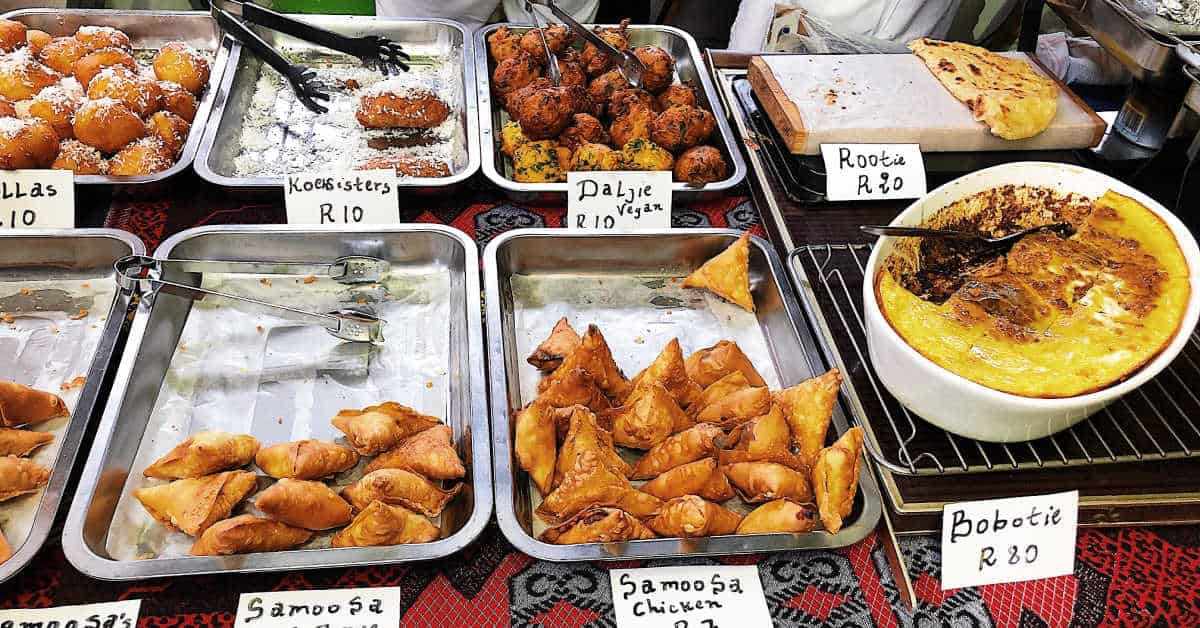
Koeksisters (top middle, you can see they go fast!)
What a fun name, right?
Pronounced “cook-sister,” this South African treat has a story as sweet as it tastes. The word “koek” means cake, and “sister” might come from “sisser,” meaning “sizzle.”
Or maybe it’s literal, referring to the way the dough is braided together like two sisters intertwined. I like to think it’s the latter. Either way, these golden pastries are basically “cake sisters,” and they live up to that adorable name.
Koeksisters are made from a simple donut-like dough that’s deep-fried until crisp, then dipped into sticky sugar syrup. They’re a Sunday tradition in many South African homes. The kind of treat that brings people together over tea and conversation.
They’re also something of a national treasure. When Prince Harry and Meghan visited the Bo-Kaap district on Heritage Day in 2019, koeksisters were proudly served with tea.
There are actually two main versions of this dessert:
→ Afrikaans Koeksister (with two k’s)
This version features tightly braided dough, deep-fried, and immediately dunked in cold syrup. That quick temperature contrast gives it a crisp shell and a syrupy center.
→ Cape Malay Koesister (with one k)
Rounder and softer, this version is spiced with cinnamon, aniseed, ginger, and cardamom, then deep-fried, dipped in hot syrup, and rolled in shredded coconut. It’s fluffier, warmer in flavor, and a little more like a traditional donut.
And if you spot something called a bolla, think of it as a baby koesister, basically South Africa’s version of a glazed donut hole. Definitely worth trying if you have a sweet tooth.
Where to Try It
While my husband and I were wandering through the Saturday market at the Old Biscuit Mill, we stumbled upon a local Cape Malay food stall serving all the South African classics such as koesisters, bollas, and more.
Both were delicious, but I have to admit, the bollas were my favorite.
I’ve always had a soft spot for cake-y desserts, and these were perfection. Ours were made with dried and ground naartjie (tangerine) peels, which added a subtle citrusy zest that made them extra special.
Cape Town Food Tour
If you really want to experience South Africa’s incredible food scene, consider joining a highly rated food tour.
My husband and I have done food tours all over the world from Madeira to Vietnam, and they’re always one of our favorite ways to dive into a country’s culture.
We didn’t have the chance to do one in Cape Town, but if you can, check out Cape Town Culinary Tours. They are known for showcasing the city’s diverse flavors and hidden gems. Reviews speak for themselves!
Final Thoughts
My husband and I have always believed the best way to experience a country is through its food, and South Africa proved that ten times over. It’s a true melting pot of cultures and flavors, each dish telling its own story.
From browsing the Saturday markets in Cape Town, to sipping wine in the Cape Winelands, to savoring unforgettable meals at our safari lodge, every stop offered something new and delicious.
If you’re a curious traveler or just someone who loves good food, you’ll fall in love with South Africa’s culinary scene. It’s bold, diverse, and full of surprises.
Enjoy every bite!

I’m Nichole, the author of all the blog posts on Enriching Pursuits. Think of me as your geeky discerning travel friend who dives deep (Google Page 20, forums, travel groups deep!) to uncover the best ways to enjoy exceptional outdoor adventures and foodie experiences.
My husband and I are experienced snorkelers, day hikers, and casual cyclists who also love delicious street food, an incredible glass of wine, and the occasional Michelin-starred meal.
Balancing full-time careers, we cherish every second of our vacation days and love sharing tips to help you do the same. If this sounds like your kind of travel, subscribe below or drop me a note with any questions. I’d love to hear from you!
Related Content

Sabi Sands vs. Kruger: Here’s How to Decide
When my husband and I were planning our South Africa...

Best South African Wine Regions (+Wineries): Our Favorites!
South African wine has officially become one of my...

We Found the Best Private South Africa Wine Tour (Review)
If you’re anything like us, you appreciate a good glass of...

Best Safari Clothes for Women You’ll Actually Want to Wear
Whenever I hear the word "safari," I instantly think khaki...
REACH OUT, FOLLOW, OR SHARE THIS POST WITH A FRIEND!
What other South African foods have you tried?
Let me know in the comments below!
0 Comments