
Fly vs. Drive Safari in Tanzania: Honest Breakdown After Doing Both
When my husband and I started planning our 8-day Tanzania safari, I quickly realized that almost every decision leads to five more decisions.
Which parks? How many nights? Which lodges? Which tour operator? And then, once you have most of that figured out, a new question shows up: are you flying between parks or driving?
It sounds like a simple logistics question. It is not. It is actually one of the bigger calls you will make because it shapes the pace, the cost, and the overall feel of the whole trip.
We ended up doing both on our 8-day Northern Circuit safari, and it turned out to be the right move for us. But the answer really does depend on your trip, your timeline, and what kind of experience you are after.
Here is what actually helped us make the decision.
* Some of the links in this post contain affiliate links. If you make a purchase through these links, we may receive a small commission at no extra cost to you. All recommendations are from first-hand experience that I feel will deliver value to you! Thank you for your continued support.
FOLLOW & SHARE WITH A FRIEND!


Quick Answer: Fly-In vs Drive Safari

Flying in our bush plane in the Tanzania Serengeti
| Your Situation | Best Option |
|---|---|
| < 5 days + closer parks (Ngorongoro, Tarangire) | Drive |
| < 5 days + Serengeti | Fly |
| 6 - 9 days | Combo (drive + fly) |
| 9+ days, outside of rainy season | Drive |
| Budget-conscious | Drive |
| Remote parks (Ruaha, Nyerere) | Fly |
Why We Did Both on Our Tanzania Safari

Our 8-day Tanzania itinerary map showing where we drove and flew
If you are doing the Northern Circuit and you are not sure which way to go, here is what I would suggest based on our experience:
Drive first. Fly later.
Start with a drive from Kilimanjaro Airport (JRO) to the Ngorongoro Crater.
You see the country.
You see the towns.
You get the guide relationship.
You arrive at the Crater having seen something real about Tanzania beyond the airport and the airstrip.
Then fly into the Serengeti. You save hours, you skip the rough road into the park, and the aerial view of the plains on the way in is genuinely one of the trip highlights.
Our itinerary on the Northern Circuit looked like this:
Flew into Kilimanjaro International Airport (JRO), drove with our private guide Savio from Pristine Trails to Craters Edge in Ngorongoro Crater.
Full day in the Ngorongoro Crater. Don't miss my detailed Crater Guide!
Drove to Lake Manyara airstrip, flew with Auric Air to Seronera in the Central Serengeti, drove to Dunia Camp.
Game drives in the Central Serengeti at Dunia Camp.
Transferred to the Eastern Serengeti for game drives at Namiri Plains. Our favorite lodge ever!
Flew from Seronera to Arusha for some fun city stops, then drove to JRO for the flight home.
The drive first, fly later structure was not something I planned with a ton of intention at the time. It just made logistical sense.
But looking back, it was genuinely the best way to experience both sides of getting around Tanzania.
We drove into the country slowly, took in the landscape, got our bearings. Then we flew when covering ground quickly actually mattered.
And if you are trying to decide between the two parks, I break down the full comparison in my Serengeti vs Ngorongoro Crater Guide.

Hi, I’m Nichole. The discerning traveler, wine lover, and adventure seeker behind Enriching Pursuits.
On this website, you'll find expert insights, honest reviews, and carefully curated experiences worth your time.
I specialize in uncovering the best outdoor adventures (especially snorkeling!), incredible foodie experiences, and boutique stays for travelers who appreciate the details as much as I do.

Want more?
Stick around, explore more, and the next time you plan a trip, just Google Enriching Pursuits!
Is this your travel style?
Then subscribe below to receive my latest updates on:
→ Boutique Stays — Hotels loaded with charm & warm service
→ Sip & Savor — Wine getaways with must-visit wineries and eats
→ Outdoor Adventures — Epic snorkeling, hikes, and bike trails
→ Foodie Finds — From hidden gems to Michelin-star dining
→ Smart Travel Gear — Product reviews that make travel better
→ Nichole Pro Tips — Save smart, splurge wisely!
What a Drive Safari in Tanzania Is Actually Like

Driving through the small towns in Tanzania on our way to the Ngorongoro Crater
A lot of people picture a drive safari as just game drives. It is not. It also includes the time in the vehicle between destinations, and on the Northern Circuit, that time can be significant.
The drive from Kilimanjaro International Airport to the Ngorongoro Crater with Savio took most of Day 1. And it was one of my favorite parts of the whole trip.
We passed through towns that were completely alive.
Motorbikes weaving through traffic, women carrying goods on their heads, roadside fruit stands piled high with mangoes and bananas, kids in school uniforms walking in groups along the shoulder of the road.
Maasai men in their red shukas tending cattle along the edge of the highway.

Stopping at Lake Manyara Viewpoint with the kids on a field trip in Tanzania
None of that is visible from a bush plane at 2,000 feet.
There is a version of Tanzania that only exists through a windshield at ground level, and I am really glad we did not skip it.
The Guide Relationship Nobody Talks About Enough

At Ngorongoro Crater in Tanzania with Savio
When you drive with a private tour operator, you have the same guide for the entire overland portion of your trip.
Our private guide, Savio, from Pristine Trails drove us from JRO, guided us through Arusha, got us to the crater, spent the full day with us inside it, and then drove us to the Lake Manyara airstrip on Day 3.
The longer you spend with your guide, the more a real rapport can develop. They get to know your travel style and what you get excited about.
And because it is private, the game drive is completely on your terms. Love lions and could not care less about birds? Your guide will spend the whole morning tracking a pride without a second thought.
With a shared safari vehicle, which is common at fly-in camps unless you pay extra for a private drive, you are also factoring in the other guests in your jeep.
They might be hardcore birders. They might be obsessed with hippos. Totally valid, but not always what you signed up for.
Savio even held onto our extra snorkeling gear from our week in the Seychelles so we could stay within the bush plane weight limits, which allowed us to do this amazing trip.
That kind of continuity is something you give up when you fly between camps and switch guides at every stop.
It is not a dealbreaker, and the Asilia guides (especially at Namiri Plains!) were also incredible.
But if you end up booking through a reputable private operator, that guide relationship is one of the most underrated parts of the overland experience.
The Honest Downsides of Driving

Getting caught in a downpour while driving in Central Serengeti
I want to be real here, because driving between parks is not all scenic road trips and mango stands.
The roads in Tanzania range from decent to genuinely rough depending on the route and the season. We traveled at the end of May, which is the tail end of the long rains, and the idea of a 3 to 4 hour muddy drive from the Crater into the Serengeti did not sound appealing at all.
That is a big part of why we chose to fly for that leg.
Long driving days also eat into game drive time, which on a short trip you really cannot afford to lose.
Driving is not a bad choice. It is just a trade-off, and it works best when you have the time and the itinerary to support it.
What a Fly-In Safari is Actually Like

Inside our Auric Air bush plane in Tanzania
Tiny plane. Dirt runway. Middle of the Serengeti. I had done plenty of research, and I still felt a little flutter of anxiety walking out to the tarmac at Lake Manyara.
And then it was completely fine. Better than fine, actually.
We flew with Auric Air, one of the most established bush plane operators in Tanzania.
They have been running these routes since 2001, use professional two-pilot crews, and hold ISSA certification.
The aircraft was a Cessna Grand Caravan EX, which is an upgraded model with a more powerful engine. It carried 12 passengers in a 1 x 2 seat layout.
The flight from Lake Manyara to Seronera took under 40 minutes. The flight from Seronera to Arusha at the end of the trip took about 50 minutes. Both were smooth, organized, and honestly kind of amazing.
I share the full experience including what boarding is actually like and the views in my bush plane guide.
What Surprised Me About Flying Between Camps

Our official boarding pass at Lake Manyara Airport in Tanzania
A few things I was not expecting:
- The interior was much nicer than I had pictured
- It was not hot, even in late May, thanks to small overhead air vents
- Both flights ran nearly on time, which I was not counting on
- The boarding process was surprisingly charming. Our first boarding pass at Lake Manyara was handwritten and labeled “Plane 2,” which made me laugh. At Seronera we got color coded passes. Ours were orange.
It is loud onboard, but not painfully so. You can still have a conversation. There are no bathrooms, so plan accordingly before you board.
I also secretly wanted the front row seat both times so I could see what the pilots see. I never got it. Maybe next trip.
The views from the air were something else entirely. We could see actual herds of animals moving across the plains below us.
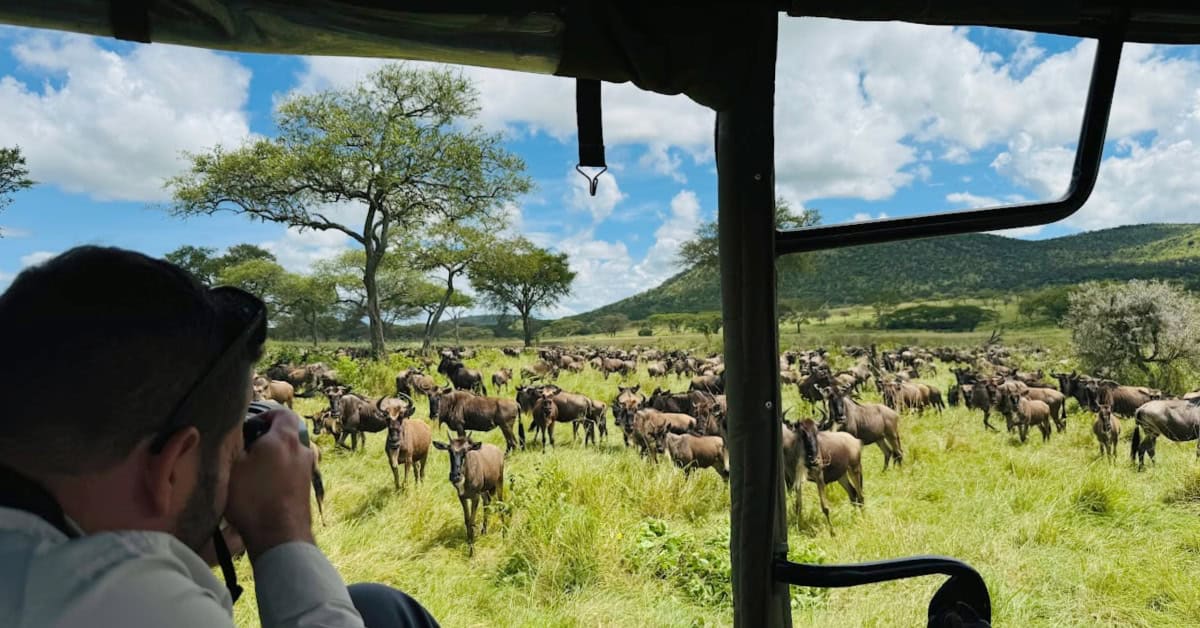
At one point, part of the Great Migration came into view, thousands of wildebeest spread out across the grass like a moving carpet. It felt less like transportation and more like an extension of the safari itself.
The Luggage Situation

Flying from Lake Manyara to Seronera on our Auric Air plane with luggage restrictions
Auric Air has a 44 lb weight limit per person, and that includes everything. Clothes, shoes, camera gear, all of it. They weigh your bags right in front of you at check-in, and they do not make exceptions (that I am aware of).
Soft-sided bags are strongly recommended. Hard shell suitcases are not going to work well in the luggage compartment of a Cessna.
We were coming to Tanzania straight from a week of snorkeling in the Seychelles, so we had extra gear with us that would have pushed us well over the limit. Savio held onto it for us from the Crater until we met up with him again in Arusha on our final day.
Here is a pro tip we learned the hard way. When you hand off your extra bags, make sure you actually know what is in them. My husband confidently handed Savio a packing cube of what he thought was his snorkeling gear.
It was not.
It was half his safari clothes. We did not figure this out until we were already in the Serengeti, at which point there was nothing to do but laugh and commit to a two-outfit rotation for five days.
He survived. The lions did not seem to care. And part of me will always be a little sad I did not get to see him roll up to a game drive in board shorts, lol.
If you are combining Tanzania with another destination or you tend to overpack, coordinate with your tour operator early about storing extra bags during the fly-in portions of your trip.
It is very manageable, but you need to plan for it.
Your Safari Vehicle Type

Closed Pop-up Roof Safari Vehicle we used in Ngorongoro Crater in Tanzania
This is something most people do not think about when deciding between a fly vs. drive safari.
If your itinerary includes a fly-in portion in Tanzania, whether that is a full fly-in safari or a combo like we did, you will likely have access to open-air safari vehicles at your Serengeti camps.
No windows, no doors, just open sides and raised seating with nothing between you and the bush. It is incredibly immersive.
Every sound, every smell, every rustle in the grass hits differently when nothing is separating you from it.
If you do a full-drive safari, you will be in a closed, pop-up-roof vehicle for the entire trip (see photo above). They are comfortable and practical, but the experience is a noticeably different feel.
We had both on our trip and loved each for different reasons. I go into all of it in detail in my Tanzania safari vehicle comparison if you want the full breakdown before you decide.
Comparing the Costs

Hubby taking photos in the pop-up safari vehicle during our drive-in safari in the Crater
Flying between parks is not cheap, but it is also not as expensive as some people assume.
Our Auric Air flights cost approximately:
- Lake Manyara to Seronera: around $200 per person
- Seronera to Arusha: around $280 per person
You can book directly through Auric Air’s website, which has a clear booking system and published routes and rates. We booked through Pristine Trails to keep everything coordinated, which was worth it for the peace of mind.
Driving costs are typically built into your private safari package, so the incremental cost of staying on the road is mostly measured in time, not dollars.
That said, fly-in camps tend to be all-inclusive at a higher nightly rate. The camps themselves often reflect the premium of being in more remote or exclusive locations.
If budget is a genuine constraint, a drive-based itinerary gives you far more flexibility across price points, from mid-range to full luxury.
A Note on the Southern Parks

Registering at the Ngorongoro Crater gate (northern circuit)
I have not been to Ruaha or Nyerere National Park, and I cannot speak to those from experience.
What I have read and heard from others is that the southern parks are spectacular, particularly if you want fewer crowds and a wilder, more remote feel.
They are also very far. Ruaha is roughly 10 hours by road from Dar es Salaam, and most travelers simply cannot spare that kind of drive time.
From everything I understand, flying is essentially the only practical way to reach those parks for most itineraries.
If the south is on your radar, I would strongly recommend talking to a knowledgeable tour operator like Pristine Trails who has firsthand experience.
So Which One Is Right for You?

Flying from Lake Manyara Airport to Seronera Airport in Tanzania
How many days you have is honestly the clearest framework for making the call.
With 5 days or fewer, drive to closer parks like Ngorongoro Crater or Tarangire.
If the Serengeti is a must, fly. With travel days on either end you only have 3 real safari days and you cannot afford to spend them in a vehicle.
With 6 to 9 days, a combo of driving and flying is the sweet spot.
You have enough time to absorb a longer transfer day on the front end and still get the most out of your time in the parks. This is exactly what we did on our 8-day trip, and it felt like the right balance the whole way through.
With 9 or more days outside of rainy season, a full drive itinerary is worth considering.
You have the runway to absorb longer transfer days without it cutting into wildlife time, and moving through Tanzania at ground level adds something to the trip that you just cannot get from the air.
A few other things worth factoring in:
- Southern parks on your itinerary: fly. It is not really optional at those distances.
- Tight budget: drive. The game drives are just as good. The wildlife does not care how you arrived.
- Comfort and efficiency are your top priorities: fly. It is smooth, professional, and landing on a dirt strip in the middle of the Serengeti never gets old.
This is one of those planning forks that shape the whole feel of the trip, and both roads are genuinely worth taking.

I’m Nichole, the author of all the blog posts on Enriching Pursuits. Think of me as your geeky discerning travel friend who dives deep (Google Page 20, forums, travel groups deep!) to uncover the best ways to enjoy exceptional outdoor adventures and foodie experiences.
My husband and I are experienced snorkelers, day hikers, and casual cyclists who also love delicious street food, an incredible glass of wine, and the occasional Michelin-starred meal.
Balancing full-time careers, we cherish every second of our vacation days and love sharing tips to help you do the same. If this sounds like your kind of travel, subscribe below or drop me a note with any questions. I’d love to hear from you!
Related Content

What to Do in Arusha, Tanzania: My 5 Favorite Things!
When my husband and I planned our amazing 8-day Tanzania...

Are Bush Planes in Tanzania Worth It? Cost, Safety, and What It’s Really Like
I was convinced I was going to be the nervous one gripping...

Best Safari Vehicle Type in Tanzania? Open vs Closed After Trying Both
After recently returning from an incredible 8-day safari...

Dunia Camp Review: Our Firsthand Serengeti Safari Experience
My husband and I did an unforgettable 8-day safari through...
REACH OUT, FOLLOW, OR SHARE THIS POST WITH A FRIEND!
Questions about our fly-in vs. drive-in safari?
Let me know in the comments below!
Well done Nichole!
I see a travel book in your future!
🥰
Thank you for reaching out and your kind comment. I really do love to share our travel experiences. 😊