
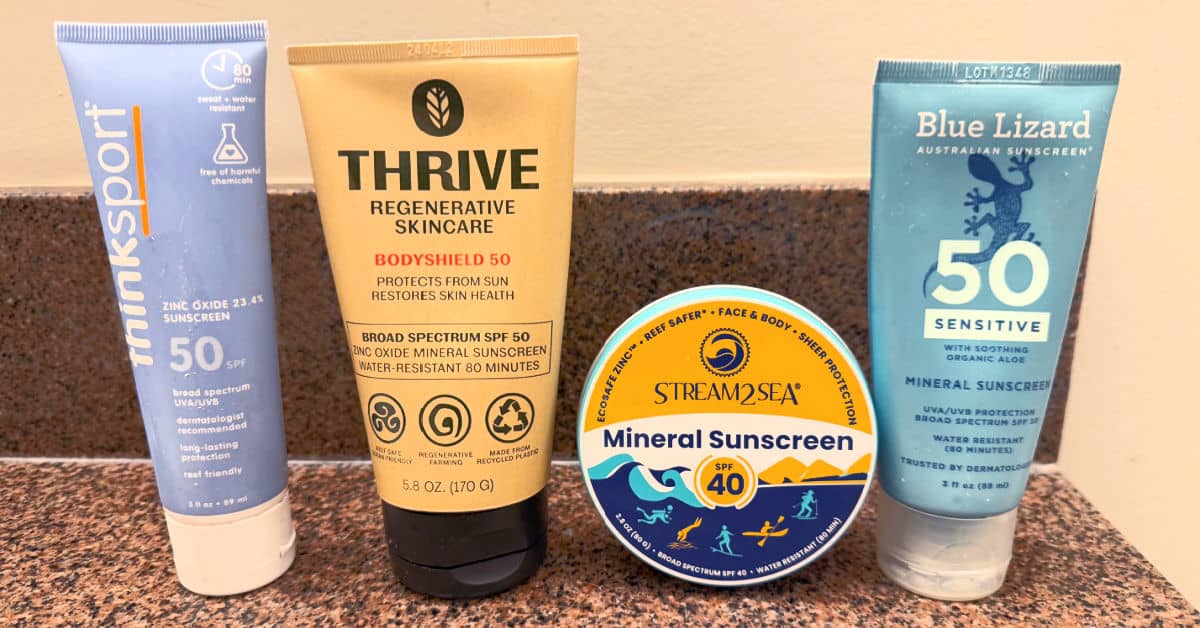
4 Best Reef Safe Sunscreens I Tested Snorkeling the World
My husband and I snorkel all over the world (87 sites to be exact!) from the Galapagos and Bonaire to Belize, Moorea, and the Maldives. We LOVE snorkeling, so I’ve tried many, many, many reef safe sunscreens. Some are good, some are way too oily, and a few are so thick they’re impossible to rub in.
Here’s the thing nobody tells you: “reef safe” doesn’t mean just one thing. In this post, I’ll share my top 4 reef safe sunscreen. Every one meets the rules of every country and territory that regulates sunscreen, and all are great for snorkeling.
Which one is best for YOU depends on your needs, so I’ll untangle the confusion around what “reef-safe” really means, break down each pick, and wrap up with a personal confession you might not expect!
* Some of the links in this post contain affiliate links. If you make a purchase through these links, we may receive a small commission at no extra cost to you. All recommendations are from first-hand experience that I feel will deliver value to you! Thank you for your continued support.
FOLLOW & SHARE WITH A FRIEND!


Quick Answer: My Top 4 Reef Safe Sunscreens
1. Best overall: Thinksport Zinc Oxide Sunscreen
2. Most hydrating: Thrive BodyShield
3. Best for sensitive skin: Stream2Sea Sport Sunscreen SPF 40
4. Best budget pick: Blue Lizard Sensitive Mineral SPF 50
Want to understand what “reef safe” actually means and how to pick between them? Keep reading. 😊
What Does Reef Safe Actually Mean?

Snorkeling the reef at Reethi Faru Resort in the Maldives
Short version: In practice, “reef safe” usually means a 100% mineral sunscreen (zinc oxide and/or titanium dioxide, with no chemical UV filters).
Mineral sunscreens are then split into two types: nano and non-nano.
Marine conservationists encourage non-nano, but I couldn’t find a single law that actually requires it, not even Maui (Ordinance No. 5306) or the Big Island (Bill 167), which have the strictest sunscreen laws in the country.
By current law, any 100% mineral sunscreen is allowed everywhere and counts as reef safe.
I personally prefer non-nano sunscreen when snorkeling over reefs as an extra precaution.
Want the full explanation? Read on.
Just want the sunscreens? Jump to my picks.
Here’s the most important thing to understand:
“Reef safe” is not a regulated term.
No agency certifies it, and any brand can print it on a bottle.
The concern behind the term is real, though. Coral reefs are declining worldwide. My husband and I first witnessed bleaching while snorkeling the Great Barrier Reef in 2012. Rising sea temperatures are the driving factor, but sunscreen washing off swimmers has been flagged as a local stressor too.
Lab studies show oxybenzone and octinoxate can harm coral (2008, 2015), but major reviews (JAAD, Environmental Sciences Europe) point out none of this has been tested under real reef conditions at realistic concentrations.
Those lab studies are why a growing list of destinations have banned specific ingredients:
| Destination | Prohibited Sunscreen Ingredients |
|---|---|
| Hawaii (statewide) | Oxybenzone, octinoxate |
| Maui County & Big Island | All chemical UV filters. Mineral sunscreens only |
| U.S. Virgin Islands | Oxybenzone, octinoxate, octocrylene |
| Palau | 10 chemicals, incl. oxybenzone, octinoxate, octocrylene, and certain parabens |
Aruba, Bonaire, and Thailand's marine national parks have similar oxybenzone-based bans.

Hi, I’m Nichole. The discerning traveler, wine lover, and adventure seeker behind Enriching Pursuits.
On this website, you'll find expert insights, honest reviews, and carefully curated experiences worth your time.
I specialize in uncovering the best outdoor adventures (especially snorkeling!), incredible foodie experiences, and boutique stays for travelers who appreciate the details as much as I do.

Want more?
Stick around, explore more, and the next time you plan a trip, just Google Enriching Pursuits!
Is this your travel style?
Then subscribe below to receive my latest updates on:
→ Boutique Stays — Hotels loaded with charm & warm service
→ Sip & Savor — Wine getaways with must-visit wineries and eats
→ Outdoor Adventures — Epic snorkeling, hikes, and bike trails
→ Foodie Finds — From hidden gems to Michelin-star dining
→ Smart Travel Gear — Product reviews that make travel better
→ Nichole Pro Tips — Save smart, splurge wisely!
Non-Nano vs. Nano: The Confusing Part

Non nano zinc oxide
Nanoparticles are mineral particles smaller than 100 nanometers. Making zinc oxide particles smaller is how brands eliminate the classic white “lifeguard nose” look.
Non-nano particles are larger, which is why they leave more of a white cast.
Is non-nano actually safer for the reef?
Here’s my honest read: the jury is still out on whether nano 100% mineral sunscreen is detrimental or not.
The concern is that nano particles are small enough to be taken up by coral and marine organisms, and some lab studies show nano zinc oxide and titanium dioxide can stress marine life at high concentrations.
But there are no conclusive studies comparing nano vs. non-nano under actual reef conditions.
And to make it murkier, “non-nano” isn’t a regulated term either. Unless a brand publishes its particle-size data, you’re taking their word for it.
So I choose non-nano when snorkeling over reefs as an extra precaution, but since every one of my picks meets every actual rule, you can honestly choose based on your skin’s needs.
My Top 4 Reef Safe Sunscreens (Reviewed)
All four of my top reef safe sunscreen picks eventually rub in with very little white cast.
Thinksport and Blue Lizard are the fastest (see my arm photos below), while Thrive and Stream2Sea take more effort, but eventually rub in.
And here’s a snorkeler-specific perk of all four being zinc-based: no eye sting. When water sneaks into your mask and sunscreen migrates into your eyes, chemical sunscreens BURN.
Zinc oxide doesn’t and after many mask clears, I can confirm none of these four has ever given me that misery.

Comparing 4 reef safe sunscreens

Demonstrating the thickness of the reef safe sunscreens

Demonstrating how fast the reef safe sunscreens rub in (Thrive and Stream2Sea take a little more effort)

All reef safe sunscreens eventually rub in
#1- Best Overall: Thinksport (non-nano)

Applying my Thinksport sunscreen in Komodo National Park in Indonesia
I wore Thinksport sunscreen all over Indonesia snorkeling with manta rays in Nusa Penida and numerous tropical fish and turtles in Komodo National Park.
No breakouts (I have acne-prone skin), and Thinksport rubbed in well. It’s one of the two fastest of the bunch. I also like there’s no real smell to it. Kinda neutral. It was also slightly more matte than oily.
Reasons I Love Thinksport
✔️ High SPF 50
✔️ One of the two fastest to rub in. The best I’ve seen for a non-nano mineral sunscreen though the very slightest sheen remains (that’s the non-nano tell!)
✔️ Fast absorbing and no stickiness
✔️ Non-nano zinc oxide
✔️ Water resistant for up to 80 minutes (I personally reapply after every snorkeling session even if it’s only been 30 minutes)
✔️ Neutral smell
✔️ Environmental Working Group (EWG) verified
✔️ Hawaii + Maui/Big Island approved
#2- Most Hydrating: Thrive (non-nano)

Demonstrating how Thrive reef safe sunscreen completely rubs in without a white cast
I also had the chance to test out Thrive BodyShield while snorkeling all over French Polynesia: the Aquarium & Tiputa Pass, Blue Lagoon in Rangiroa, Coral Garden in Taha’a, and Moorea.
Honestly, it’s really splitting hairs between Thinksport and Thrive. Both are great options. With frequent application, no burns.
Thrive has a slightly more hydrating feel (possibly due to the added super plant ingredients). It does take more effort to rub in than Thinksport or Blue Lizard, but the hydrating payoff is worth it if your skin runs dry.
A note on scent: Thrive uses a natural fragrance blend: orange, grapefruit, lemon, anise, guaiacwood, cedarwood, peppermint, davana, patchouli, and vetiver oils. Most people describe it as citrus; to my nose it’s actually more peppermint.
Either way, it’s the most noticeable scent of the four . If you’re sensitive to fragrance, that’s something to consider.
Reasons I Love Thrive Sunscreen
✔️ High SPF 50
✔️ Most hydrating of the bunch: super plant ingredients such as larch tree and macadamia
✔️ No stickiness once rubbed in, with only the slightest sheen remaining
✔️ Non-nano zinc oxide
✔️ Water resistant for up to 80 minutes
✔️ Pleasant natural scent (citrus to most, peppermint to me)
✔️ Recycled-plastic tube, and purchases help restore farmland in Costa Rica
✔️ Hawaii + Maui/Big Island approved
#3- Best for Sensitive Skin: Stream2Sea (non-nano)

Showing the Steam2Sea Sport Sunscreen
We used Stream2Sea Sport Sunscreen snorkeling all over the Galapagos, and it held up very well.
Stream2Sea has the most hardcore reef credentials of any sunscreen I’ve tested: the company states it’s the only sunscreen brand that has actually tested its products on fish and coral larvae to prove they’re safe … not just removed the banned ingredients!
Fair warning on application: Stream2Sea is the toughest of the four to rub in.
But here’s the thing: that tenacity is the point. This beeswax-based balm is hard to get on and hard to get off. It genuinely stays put through long swims and only fully comes off with a soapy washcloth.
For snorkelers, “hard to wash off” is exactly what you want. One tip: apply early and let it dry completely before getting in the water.
The payoff is a very matte finish plus a calming organic antioxidant blend (olive leaf, green tea, wakame seaweed, and tulsi).
Zinc oxide and green tea are both anti-inflammatory, and there’s no added fragrance, which is why this is my pick for sensitive skin.
Reasons I Love Stream2Sea Sport
✔️ SPF 40
✔️ Non-nano zinc oxide
✔️ Actually tested on fish and coral larvae (the strongest reef claim in this entire post)
✔️ Stays put in the water better than any sunscreen I’ve tested. Hard on, hard off
✔️ Very matte finish
✔️ Organic antioxidant blend (olive leaf, green tea, wakame, tulsi) soothes the skin
✔️ No added fragrance
✔️ Water resistant for up to 80 minutes
✔️ Environmental Working Group (EWG) verified
✔️ Hawaii + Maui/Big Island approved
✔️ Plastic-free
#4- Best Budget Pick: Blue Lizard

Using Blue Lizard while cruising around the Galapagos
Blue Lizard has been a dermatologist-recommended brand for over 20 years, and their Sensitive Skin Mineral Sunscreen formula is the value pick of the bunch.
Along with Thinksport it’s one of the two fastest to rub in.
✔️ 100% mineral: zinc oxide + titanium dioxide, no chemical UV filters
✔️ No oxybenzone or octinoxate
✔️ Fragrance-free and paraben-free
✔️ One of the two fastest of the four to rub in
✔️ Water resistant for up to 80 minutes
✔️ Lowest bottle price of the bunch, usually under $15
✔️ Hawaii + Maui/Big Island approved
A note on particle size (full transparency): Unlike the other three picks, Blue Lizard doesn’t state whether its minerals are non-nano.
Their own reef statement “We ♥ the Reef” defines reef-friendly by the State of Hawaii’s standard: no oxybenzone, no octinoxate. That qualifies it as reef safe under that current rule.
But if verified non-nano matters to you, one of my top 3 picks is the safer bet.
Side-by-Side Comparison
| Thinksport | Thrive | Stream2Sea | Blue Lizard | |
|---|---|---|---|---|
| Best for | Overall pick | Hydration | Sensitive skin | Budget |
| SPF | 50 | 50 | 40 | 50 |
| Particle size | Non-nano | Non-nano | Non-nano | Not disclosed |
| Active filters | Zinc oxide | Zinc oxide | Zinc oxide | Zinc oxide + titanium dioxide |
| Oxybenzone / octinoxate | Free | Free | Free | Free |
| Hawaii Approved | ✔️ | ✔️ | ✔️ | ✔️ |
| Water resistance | 80 min | 80 min | 80 min (stays put the best) | 80 min |
| Rub-in effort | Fastest (tied) | More effort | More effort | Fastest (tied) |
| Finish | Slightly matte | Hydrating | Very matte | Light |
| Scent | Neutral scent | Natural fragrance | No added fragrance | No added fragrance |
| Cost | $$ | $$ | $$$ | $ |
Which One Should You Pick?

Clownfish darting in and out of sea anemones at Coral Garden Taha’a
All four are great for snorkeling. It really depends on your needs:
- Want the best overall? Thinksport. It’s been my #1 for years.
- Skin runs dry, or you hate the tight sunscreen feel? Thrive, the most hydrating of the bunch. Just know it’s the most scented.
- Sensitive skin or you want the sunscreen that stays put the longest? Stream2Sea is matte, calming, fragrance-free, and tested on actual coral larvae. Budget extra rub-in time.
- Sunscreen for the whole family at the lowest bottle price? Blue Lizard, the value pick, and one of the easiest to apply.
And whichever you choose, reapply after every snorkel session. Even the best 80-minute water resistance doesn’t survive a long swim plus a towel-off.
Honest Confession

Getting ready to snorkel at Muelle Tijeretas in San Cristobal
If I’m being completely honest, I don’t care for reef safe sunscreens.
Despite generous application, I burn faster when using reef safe sunscreens. So FREQUENT application is very important.
What’s the solution?
Sun shirts + swim leggings! They protect you, and they protect the reef.
Coolibar and Tuga are some of my favorite brands for sun protective shirts. I wear them on all snorkeling adventures.
Then all you need is a little reef safe sunscreen on the back of the neck, ears, face, and hands (but now I’ve started to wear sun gloves!). My feet are already covered with dive booties because I wear open-heel snorkeling fins.
Plus, significantly less sunscreen is washing off in the ocean when I wear sun shirts and leggings. Win-win.
In summary, sun protective clothing is the “BEST SUNSCREEN” for the reef.
Reef Safe Sunscreen FAQ
Is “reef safe” a regulated term? No. No agency defines or certifies “reef safe,” so any brand can use it. That’s why I break down both the actual rules and the nano debate above so you can decide for yourself.
Are all four of these sunscreens legal in Hawaii? Yes, Thinksport Zinc Oxide sunscreen, Thrive BodyShield, Steam2Sea Sport Sunscreen, and Blue Lizard Sensitive Mineral Sunscreen are Hawaii safe. Hawaii’s Act 104 bans oxybenzone and octinoxate statewide, and all four are free of both. Maui County and the Big Island additionally allow only mineral sunscreens. All four are 100% mineral.
Does anywhere require non-nano sunscreen? No. I have not found a single country, state, or territory that requires non-nano. Every existing rule is satisfied by any 100% mineral sunscreen. Non-nano is my personal precaution, not a legal requirement.
Is nano mineral sunscreen bad for coral? The jury is still out. Some lab studies suggest nano zinc oxide and titanium dioxide can harm marine organisms at high concentrations, but there’s no conclusive evidence under real-world reef conditions. I lean non-nano when snorkeling as a precaution.
How can I tell if a mineral sunscreen is nano or non-nano? Unless the brand explicitly says “non-nano” (like Thinksport, Thrive, and Stream2Sea do), assume you can’t know for sure. My rule of thumb: nano mineral sunscreens rub in perfectly invisible. Non-nano formulas leave a very slight white sheen no matter how well you rub them in.
Do mineral sunscreens sting your eyes while snorkeling? In my experience, no. That’s one of the underrated perks. Chemical sunscreens migrating into your eyes inside a leaky mask BURN. All four of these are zinc-based, and none has ever stung my eyes.
What’s actually the best sunscreen for the reef? A rash guard. See my Honest Confession above. 😊

I’m Nichole, the author of all the blog posts on Enriching Pursuits. Think of me as your geeky discerning travel friend who dives deep (Google Page 20, forums, travel groups deep!) to uncover the best ways to enjoy exceptional outdoor adventures and foodie experiences.
My husband and I are experienced snorkelers, day hikers, and casual cyclists who also love delicious street food, an incredible glass of wine, and the occasional Michelin-starred meal.
Balancing full-time careers, we cherish every second of our vacation days and love sharing tips to help you do the same. If this sounds like your kind of travel, subscribe below or drop me a note with any questions. I’d love to hear from you!
Related Content

Dry vs Semi-Dry Snorkel: Which Should You Buy?
The first snorkel I ever bought was a dry snorkel, and I...

Scuba Diving vs. Snorkeling Fins: Don’t Buy the Wrong Pair!
Snorkeling and scuba diving fins might look similar at...

Full Foot vs. Open Heel Fins: Why I’ll Always Pick the Latter for Snorkeling
Full foot vs. Open Heel Fins: Is there a big difference...

3 Best Travel Towels: A Snorkeler’s Perspective
My husband and I snorkel all over the world: Belize,...
REACH OUT, FOLLOW, OR SHARE THIS POST WITH A FRIEND!