
Ultimate Safari Packing List: Real Tips from Three Safaris
There’s nothing quite like an African safari. Even if it’s your tenth game drive, that sunrise moment when you step into the jeep always hits you like the very first time. My husband and I have now done safaris in Chobe (Botswana), Sabi Sands (South Africa), and most recently the Serengeti in Tanzania. And after all these trips, I’ve learned exactly what’s worth packing and what can stay home.
Here are the items I always pack now … plus a few things you absolutely don’t need.
* Some of the links in this post contain affiliate links. If you make a purchase through these links, we may receive a small commission at no extra cost to you. All recommendations are from first-hand experience that I feel will deliver value to you! Thank you for your continued support.
FOLLOW & SHARE WITH A FRIEND!


TL;DR Safari Packing List

Standing in front of our tent at Namiri Plains in Tanzania
If you don’t feel like reading through all the details in this article, here’s the short and sweet version of exactly what I packed on our 8-day safari.
If you want more info on any of these items, just scroll to the matching section.
I added tons of photos and personal notes there.
01- Clothing
Tops 👕 x 7
- 4 lightweight, breathable long-sleeved linen shirts
- 2 Vuori white tanks to wear underneath the long-sleeved shirts
- 1 sweatshirt or fleece for layering on those cool morning game drives.
Bottoms 👖 x 5
- 4 pairs of lightweight, quick-dry pants
- 1 pair of Willit shorts for lounging around the lodge
Outerwear 🧥 x 1 + 🧣
- Lightweight puffer jacket for chilly mornings.
- Multi-colored scarf for a pop of color and for dust and sun protection.
Accessories 🕶️ + 👒
Bathing Suit 👙 x 1
- If your safari lodge has a pool, make sure to bring a bathing suit.
Lots of underwear
- Often lodges do not launder underwear, so bring plenty!
02- Footwear
Footwear 🥾 x 3
- Comfortable Brooks trail runners
- Rothy’s RS02 sneakers
- Cole Haan sandals for relaxing at the lodge in the evenings.
- Consider heavier ankle boots if you are doing a walking safari.
03- Toiletries & Health
Bug Spray
- Ben’s insect repellent
Sunscreen
- For face, Elta MD UV Clear
- For body, La Roche-Posay water resistant sunscreen
Personal Medications 💊
- Imodium
- Azithromycin
- Travelan
- Malaria Pills
- Allegra
- Benadryl
- Topical Steroid + Low-Dose Steroid Pack
- Melatonin
- Fabric bandages + antibiotic ointment
Electrolyte Mix
Hand Sanitizer
- Travel size hand sanitizer
Nose & Lip Care
04- Gear
Small Daypack 🎒
- Packable Zomake bag for safari drives
Binoculars (if the lodge does not have them)
- Small pair of binoculars
Headlamp 🔦
- Headlamp or flashlight
Travel Towel
Travel Adapter
Soft-sided Suitcase 🧳
05- Photography
Good Camera 📷
Wide Angle Lens
Telephoto Zoom Lens
GoPro
06- Nice to Haves
01- Safari Clothing

Hubby and I sporting our lightweight sun protective clothing at Chobe National Park
Lightweight Tops & Bottoms
Not sure what to wear on safari? I wasn’t either before our first trip.
Now that I’ve been on three safari adventures, I’ve learned exactly what works and what definitely doesn’t.
When I first started shopping for safari clothes, every recommendation looked like the same khaki uniform loaded with pockets.
Functional? Sure. Cute? Not at all.
So I changed my approach and focused on outdoor brands instead of traditional “safari” labels, and that made all the difference.
I found lightweight, breathable, sun-protective pieces from Orvis, Kühl, Eddie Bauer, Vuori, and Prana in much more flattering colors like green, grey, soft pink, and light blue.
Still totally safari-appropriate, just far more stylish and versatile.
And if you want more recommendations on the best safari clothing (plus examples of the exact outfits I wore!), don’t miss my blog post on what clothes to pack for your next safari adventure.

Hi, I’m Nichole. The discerning traveler, wine lover, and adventure seeker behind Enriching Pursuits.
On this website, you'll find expert insights, honest reviews, and carefully curated experiences worth your time.
I specialize in uncovering the best outdoor adventures (especially snorkeling!), incredible foodie experiences, and boutique stays for travelers who appreciate the details as much as I do.

Want more?
Stick around, explore more, and the next time you plan a trip, just Google Enriching Pursuits!
Is this your travel style?
Then subscribe below to receive my latest updates on:
→ Boutique Stays — Hotels loaded with charm & warm service
→ Sip & Savor — Wine getaways with must-visit wineries and eats
→ Outdoor Adventures — Epic snorkeling, hikes, and bike trails
→ Foodie Finds — From hidden gems to Michelin-star dining
→ Smart Travel Gear — Product reviews that make travel better
→ Nichole Pro Tips — Save smart, splurge wisely!
Nichole Pro Tip: I roll my clothing tightly with a dryer sheet into a compression packing cube to maximize space and make my clothes smell nice.
Lightweight Puffer

Wearing my light down jacket with our safari ranger and tracker at Lion Sands River Lodge
Of course, the decision to bring a jacket will depend on the time of year you are going. When we went to South Africa in September and Tanzania in May, the mornings were chilly!
Layer, layer, layer.
I wore a lightweight packable puffer jacket that was water resistant.
Scarf

Picture of myself photographing a rhino while on a South Africa safari at Lion Sands River Lodge
I packed a multi-colored scarf that worked with all my outfits. Here’s why I’m glad I brought one:
→ Warmth
Morning game drives can be chilly, with temps in the mid-50s°F. A scarf adds quick neck warmth, even with the blankets provided. On one cold drive, I wished I’d also packed a beanie and gloves—check the forecast and plan accordingly.
→ Dust
Open-top jeeps expose you to dust. A scarf is great for wiping your face or hands and can even help clean your camera lens in a pinch.
→ Sun Protection
The sun is strong, especially on the back of your neck. A scarf adds simple, effective coverage from harsh UV rays (and from bug bites!).
Safari Hat

Enjoying a delicious bush breakfast in Tanzania
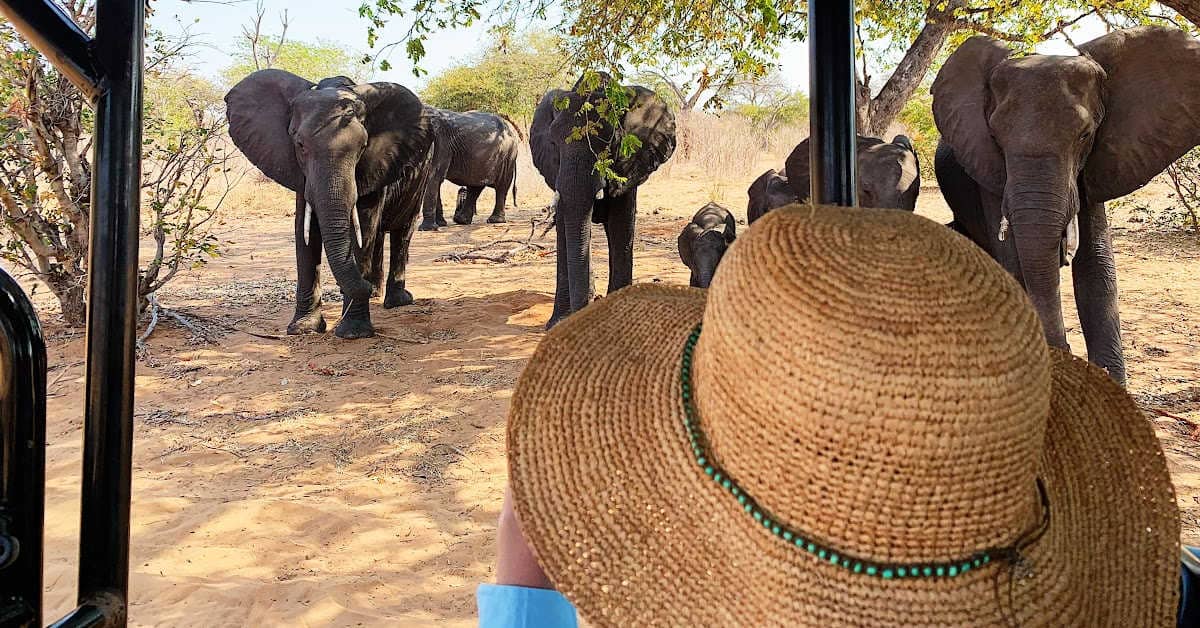
A hat is an absolute must for your safari packing list.
Without one, the intense sun can quickly take its toll. There are plenty of stylish and practical options to choose from.
One of my favorites is my packable FURTALK sun hat. It “squishes” down nicely in my luggage. I’ve used it all over the Caribbean and on safari.
Polarized Sunglasses

Wearing my polarized sunglasses in our safari jeep in the eastern Serengeti in Tanzania
Love polarized sunglasses!
They reduce eye strain and cut down the glare especially when you are looking for animals in the distance on your safari.
My favorites are from Ray-Ban.
Bathing Suit

Swimming in Devil’s Pool at Victoria Falls on the Zambia side
If your safari lodge has a pool, don’t forget the bathing suit!
We did one of the most epic experiences I have ever done … swimming in Devil’s Pool on top of Victoria Falls, the world’s largest waterfall! So I was already planning on bringing a bathing suit when we went to South Africa.
When we were in Sabi Sands at the end of September, it was too chilly to swim in the lodge’s pool. Check the weather before you go.
Lots of Underwear
Don’t skimp on underwear.
Some safari lodges won’t launder it for cultural reasons. Check with your lodge ahead of time, so you know how much to pack.
Otherwise, bring a small packet of laundry detergent and hand-wash items in the sink as needed.
You can also look into “travel underwear.” My husband swears by the ExOfficio boxer briefs, which are quick-drying, breathable, and treated with odor-reducing technology.
ExOfficio also makes high-performance, chafe-free options for women.
As for bras, many women prefer sports bras since safari rides can get bumpy earning their nickname, the “African massage.”
Nichole Pro Tip: If you have a dermatologist, ask for samples of hypoallergenic laundry detergent. They often have them, and they’re perfect for travel.
02- Safari Footwear

Wearing my Brooks Cascadia Trail Runners on a safari drive (posing with a leopard tortoise) in the Serengeti in Tanzania
Trail Runners
Trail running shoes like the Brooks pair I wore in Tanzania are an excellent choice for safari drives.
They’re lightweight, comfortable, and offer enough tread for uneven terrain.
They also do double duty: perfect for the gym if your lodge has one, and ideal for spontaneous hikes, especially if places like Cape Town are on your Africa itinerary.
We hiked Lion’s Head in Cape Town, and my Brooks handled both the safari and the hike perfectly.
Rothy’s Sneakers
I wore Rothy’s RS02 Sneakers on transfer days between safari lodges during our Tanzania circuit, and they were perfect.
They were also my go-to “travel shoe” for the long international flights.
Plus, they also worked well as a casual shoe for relaxing around the lodge and added a nice touch to dress up outfits for lodge dinners.
Cole Haan Sandals
My go-to travel sandal is the Cole Haan Flynn.
They’re incredibly soft and comfortable, truly like butter on my feet.
I wore them around the safari lodge and to dinners when I wanted to elevate an outfit a bit. They were the perfect way to give my feet a break after a long day.
03- Toiletries & Health Essentials

What my Zomake bag carried on the safari jeep (photo taken at Namiri Plains) which always included sunscreen and bug spray!
Bug Spray
Malaria is a real thing in many parts of Africa, so skip the citronella bracelets and go straight for the good stuff.
My travel clinic recommended 30% DEET. Anything higher doesn’t protect you more, it just lasts longer. The CDC says 20%+ is enough, so you’ve got options.
You can use sprays, wipes, lotions, whatever works. I prefer a roll-on or classic spray.
You can also pre-treat your clothes with Permethrin, which tons of hikers swear by. Sawyer’s version supposedly lasts up to 6 weeks or 6 washes.
I always intend to treat my clothes before safari … but have I ever actually done it? Nope. If you’ve tried it, tell me in the comments.
Common-sense stuff helps too: long sleeves, long pants, avoiding peak mosquito times, and staying away from standing water.
Or you can try to do what we did at Dunia Camp in the central Serengeti and swat the little guys away with a horse-tail fly swatter.
Surprisingly satisfying but DEET works better.

Getting ready to transfer to Dunia Camp in the central Serengeti
Sunscreen
And don’t underestimate the African sun.
It’s intense. My husband and I snorkel all over the world, so we’ve tested a lot of sunscreens.
For my face, I love EltaMD UV Clear. It’s zinc-based but rubs in sheer and never feels oily.
For my body, I use La Roche-Posay’s water-resistant sunscreen. It lasts, it protects, and it doesn’t leave you greasy.
Personal Medications

The exact personal medications I brought on safari
I basically travel with my own mini-pharmacy because you never know what you’ll need, especially on safari.
Here’s what I brought, but definitely check with your doctor about what’s right for you.
✔️ Imodium + Azithromycin
Traveler’s diarrhea is brutal, and you do not want it when you’re hours from a bathroom in the African bush.
I carry Imodium for emergencies and ask my travel clinic for an antibiotic like Azithromycin, just in case.
✔️ Travelan
My new travel buddy.
Travelan may help prevent traveler’s diarrhea. I took it in Mexico City (hello, street tacos!), Bali (no Bali Belly for me!), and on our Tanzania trip. No issues on any of them, which is rare for me.
Pop one or two before meals. Placebo? Magic? No idea, but it worked.
✔️ Malaria Pills
Always check CDC recommendations for your destination.
Options include Doxycycline, Malarone, Mefloquine, and Tafenoquine. I use Malarone because Doxy makes you sun-sensitive and Mefloquine can cause wild dreams. No weird side effects for me so far.
✔️ Motrin & Tylenol
For fevers, headaches, aches, and “my body doesn’t bounce back like it used to,” Motrin and Tylenol are truly essential.
✔️ Antihistamines
Allergies? Bug bites? Allegra is my go-to because it’s non-drowsy.
Benadryl works too, but unless you want to nap through a lion sighting, save it for bedtime.
✔️ Topical Steroid + Low-Dose Steroid Pack
If you react badly to bites like I do (I balloon and blister), ask your doc about Triamcinolone 0.1% cream and a Medrol Dosepak. Total lifesavers.
✔️ Melatonin
My husband swears by it for jet lag. I never used it until I got insomnia right before our Africa trip, probably from stressing about swimming in Devil’s Pool and shark cage diving.
Melatonin saved me and helped with jet lag at the start of our trip.
✔️ Fabric Bandages + Antibiotic Ointment
You’ll get a blister or two. I like Bactroban for cuts (ask your doc) and good fabric bandages.
Don’t cheap out. Bandaids are like toilet paper: you notice when you buy the bargain ones.
Electrolyte Mix + Water Bottle

My Gatorade packets for hydration
Hydration on safari is key.
You’re out on long game drives (think 3 hours in the morning and 3 in the afternoon), and that sun can sneak up on you fast. The last thing you want is to get woozy in the middle of lion country.
Bring a good water bottle, or check if your lodge hands them out.
Lion Sands River Lodge, Namiri Plains, and Dunia Camp all gave us bottles to use during our stay, which made life easy.
I also pack low-sugar Gatorade packets on every trip.
Total lifesavers when you’re dehydrated … or recovering from “one more glass” at dinner. Just add to water and shake.
I lovingly call it my hummingbird juice because every time I’m dragging, it zips me right back to life.
Hand Sanitizer

Prepared with Kleenex and hand sanitizer before peeing in the bush (hoping there’s no lions!)
Even before the whole COVID era, we always traveled with disinfectant wipes and travel-size hand sanitizer.
They’re super handy on planes, hikes, and safari drives, especially when you’re about to eat a snack.
And they’re also great to have when you have to pee in the bush!
Speaking of peeing in the bush.
Some women swear by those little urination funnels for outdoor use. I haven’t personally tried one but something to consider.
Nose & Lip Care
Safari days are dusty.
Between the sun, wind, and hours riding around in an open vehicle, your lips get parched and the dust works its way up your nose pretty quickly.
Two tiny items saved me:
→ Aquaphor Lip Ointment
I slather this ointment on nonstop. You can even spot my tube sitting on the bed at Namiri Plains in that earlier photo of my Zomake bag and everything I packed.
→ Moisturizing Saline Nasal Spray
After every game drive, I’d use a quick spritz in each nostril. The spray helps wash out dust, soothe irritation, and keep your nose from drying out (trust me, you’ll feel the difference instantly).
Small items, huge upgrade to your comfort.
04- Gear & Accessories

My Zomake daypack on the safari jeep in Tanzania
Small Daypack
You’ll definitely need a bag to keep your essentials organized on the safari jeep.
My husband and I used these compact Zomake daypacks from Amazon.
They fold down into a tiny pouch, making them easy to pack.
They’re lightweight, come in several colors, and were the perfect size for everything I needed: my camera, power bank, hat, sunscreen, water bottle, scarf, bug spray, hand sanitizer, and a small brush.
The bags are washable (delicate cycle, then air-dry), which is key since they’ll rest on the jeep floor and pick up dirt. For that reason, I wouldn’t recommend bringing an expensive bag.

Zomake bag at Chalkley Treehouse at Lion Sands River Lodge in Sabi Sand
We also used our Zomake bag while spending a night under the stars at Chalkley Treehouse in the African bush.
Epic experience on our 2-week Africa adventure!
Binoculars

Using binoculars to scan the Chobe River in Botswana trying to find some animals
When we took a day trip to Chobe National Park in Botswana, binoculars were not provided.
However, during our safaris at Lion Sands River Lodge in Sabi Sand, South Africa, and in the Serengeti in Tanzania, they were provided.
Check with your lodge ahead of time. If they supply binoculars, that’s one less item to pack.
They’re incredibly useful for scanning the distance and spotting movement.
We bought a pair on Amazon that worked perfectly for our trips
Headlamp

My headlamp
On our first safari, my husband and I packed all the essentials like binoculars, sunscreen, and our camera.
But one thing we nearly forgot (and now consider a must-have) was a good headlamp.
Many safari camps have limited lighting and rely on generators that shut off at night.
Having your hands free in the dark, whether you are getting ready for an early morning game drive or simply trying to brush your teeth without dropping anything, makes a big difference.
Travel Towel

Rainleaf Travel Towel
You will get hot, sweaty, and dusty on safari.
I can’t tell you how many times I’ve needed to wipe my face, clean my camera lens, or dab off the drink I managed to spill while bouncing around in the jeep.
So I always bring a towel that’s lightweight, super absorbent, and packs down tiny.
We’ve tried a bunch of compact towels over the years, from safaris to snorkeling trips, and the one we keep coming back to is the Rainleaf towel.
Travel Adapter

Type G adapter for Tanzania (picture taken at Wilderness Collection Crater’s Edge in Ngorongoro Crater)
I always pack my travel adapter first because it’s the one thing that’s annoyingly easy to forget.
Tanzania uses Type G outlets, which you can see in my photo above (taken at Ngorongoro Crater at Wilderness Collection Crater’s Edge).
South Africa uses Type M.
I’m loyal to the Tessan brand.
Their adapter plug with USB-C has been my go-to for years.
It has two USB ports, one USB-C port, and four outlets, so I can charge up to 7 devices without playing musical chairs with cords.
It’s also very lightweight at only four ounces. Every ounce counts on those little bush planes!
Soft-sided Suitcase

Soft-sided Travelpro suitcase (as pictured at The Wilderness Collection Craters Edge in Tanzania)
I brought my trusty soft-sided Travelpro Platinum Magna Rollaboard (now the Platinum Elite) for our safari.
I’ve had it since 2013, taken it to 36 countries, and only needed one repair. And that was 100% my fault for dragging it over Roman cobblestones.
Travelpro replaced the wheel under their lifetime warranty, and I’ve been loyal to the bag ever since.
So, why a soft-sided suitcase?
Safari vehicles don’t have much space, and those little safari planes are super strict about weight.
On our South Africa Airlink flight from Cape Town to Skukuza, the limit was 20 kg (44 lbs). Some countries go as low as 15 kg (33 lbs). If you’re taking one of the tiny prop planes, a soft-sided duffel or suitcase is basically a must.
Some airports, like Skukuza, even let you store your main luggage for free, so you can just toss your safari clothes into a duffel for the small plane ride.

Husband took this awkward photo of me, lol, but I wanted to show you the bush plane at Seronera Airport in Tanzania
In Tanzania, we flew Auric Air and they were firm about 20 kg max and specific bag dimensions. No sneaking around it.
The tricky part was that we were on a two-week trip, starting with five nights in the Seychelles (we are big snorkelers) and then seven nights in Tanzania.
Our snorkel gear (masks, fins, all of it) would have pushed us over the weight limit on the small Auric flight.
Savio, our safari guide with Pristine Trails, completely saved us. After we finished our time with him at Ngorongoro Crater, he took our snorkel gear so we could stay under the limit while we flew from Lake Manyara Airport to Seronera Airport for our Serengeti safari.
When he met us again at Arusha Airport, he handed everything back to us safe and sound.
05- Photography & Electronics

Hubby is photographing the Great Migration near Dunia Camp in the central Serengeti in Tanzania
A Good Camera
I took tons of photos and videos on my iPhone (that’s me in the pic below), and it was awesome for close-up moments when animals were literally right next to our Jeep.

Me capturing the lion action at sunset near Namiri Plains in Tanzania
But anytime something was farther away and I tried to zoom, it was a grainy mess.
That’s why I was so grateful my husband brought our Canon Rebel DSLR. It made all the difference out in the Serengeti.
The shots from the DSLR were insanely crisp and detailed.
Here is one of my favorite photos my husband took of a cheetah cub on our Tanzania trip that still makes my heart melt.

Mom and baby cheetah relaxing for a moment in the Tanzania Serengeti
Wide-Angle Lens

Chalkley Treehouse: photographed with the Canon Rebel DSLR and wide-angle lens
We brought three lenses on our safari:
- Wide-angle lens
- Normal lens
- Telephoto zoom lens
The wide-angle lens was perfect for those sweeping landscape shots.
It’s also how we captured that amazing photo of Chalkley Treehouse (above), which ended up being one of our favorite romantic moments of the whole trip.
Telephoto Zoom Lens

Hubby taking a photo with the telephoto zoom lens at the Ngorongoro Crater in Tanzania
But the real MVP on safari?
You need one. The two photos below say it all: the first is with our Canon telephoto zoom lens, the second is with my iPhone.
Without that telephoto lens, there’s no way we would’ve gotten that adorable close-up of the tiny turtle hitching a ride.
Same with the photo of the very full, very satisfied leopard lounging in a tree. Totally impossible on an iPhone.

Telephoto Lens: Turtle hitching a ride on a hippo

iPhone: Turtle riding a hippo in Sabi Sand South Africa

Telephoto Lens: Sleepy leopard in the tree in Tanzania
GoPro

GoPro Hero
My GoPro was awesome on safari.
The stabilization (great for those bumpy jeep rides) and the wide-angle view made it perfect for filming our game drives.
I also used it when we slept under the stars in the treehouse at Lion Sands River Lodge in Sabi Sand. One of the coolest experiences we’ve ever had! The GoPro got amazing footage there.
And before we even got to Tanzania, it pulled double duty while snorkeling in the Seychelles, where we got some great videos.
It even survived Devil’s Pool at Victoria Falls in Zambia, where I filmed while literally hanging over the edge.
06- Nice-to-Haves

My white noise machine
White Noise Machine
Okay, hear me out. This is probably the weirdest thing on my safari packing list, and I fully accept that it might sound a little dramatic.
But I will defend this item forever.
As I’ve gotten older, sleep has become non-negotiable. In my 20s and 30s, I could go out, get four hours of sleep, and still function. Now? If I don’t sleep, I turn into a gremlin.
This is why I bring my secret weapon everywhere:
It weighs basically nothing (3.6 ounces!), makes perfect white noise, and even works as a little Bluetooth speaker.
And yes, I brought it on safari. And yes, I used it.
When our guide knocked on the door at 5 a.m. for our morning game drive, I actually felt rested, even with the nighttime wildlife soundtrack happening outside.
Thank You Notes

Thank you note cards
Something I didn’t fully appreciate until we actually went on safari is how hard the guides and trackers work.
Our guides were up before sunrise every single day, and they didn’t head to bed until long after we were already passed out.
They spent hours with us … patiently teaching us, answering a million questions, and somehow spotting animals I never would’ve seen on my own.
Because of that, I’ve made it a habit to always leave a thank-you note and an appropriate tip. It’s a small way to acknowledge how much effort they put in to making the experience exceptional.
Every time we’ve done it, the staff has been so genuinely appreciative. It really does make a difference.
What Not to Pack
Remember there are luggage weight limits on those small safari planes, so only take what you absolutely need.
Here’s what not to pack:
- No drones.
- No hair dryers. Your safari lodge should already provide one but always double-check. I found out the hard way one of our camps did not provide hair dryers, so consider bringing a dry shampoo.
- No camouflage clothing.
- No single-use plastic bags. They are banned in countries such as Tanzania, Uganda, Kenya, and Rwanda.
Final Thoughts
You made it to the end of my ultimate safari packing list! I know this was a long one!
If you’re anything like I was before my first safari, you’re probably sorting through a million recommendations and wondering what actually matters.
Hopefully, this guide cleared things up and made packing way less overwhelming.
A safari really is one of those life experiences you’ll never forget.
And if this is your first time heading out, don’t miss my posts:
→ 11 things to look for in a safari lodge
They’ll help you feel way more prepared!

I’m Nichole, the author of all the blog posts on Enriching Pursuits. Think of me as your geeky discerning travel friend who dives deep (Google Page 20, forums, travel groups deep!) to uncover the best ways to enjoy exceptional outdoor adventures and foodie experiences.
My husband and I are experienced snorkelers, day hikers, and casual cyclists who also love delicious street food, an incredible glass of wine, and the occasional Michelin-starred meal.
Balancing full-time careers, we cherish every second of our vacation days and love sharing tips to help you do the same. If this sounds like your kind of travel, subscribe below or drop me a note with any questions. I’d love to hear from you!
Related Content

A Typical Day on Safari: Behind the Scenes Look
Waking up in the African bush is an experience like no...

Our Self-Guided Wine Tour in Stellenbosch & Franschhoek
So, South Africa isn’t just about safaris and epic...

How to Choose an African Safari Lodge: 11 Things to Consider
Choosing the right African safari lodge can feel...

7 Top Safari Destinations: Insider’s Pros and Cons Guide
My husband and I have done safaris in South Africa,...
REACH OUT, FOLLOW, OR SHARE THIS POST WITH A FRIEND!
Any African safari packing list items that I missed? Questions on what to bring?
Let me know in the comments below!
Love your style and information! Heading to South Africa and 3 safaris next month, now I know what to bring! Thank you!
Just a quick note about female urinary devices, I have tried them all, the only one that works is hard plastic NOT flexible, Freshette brand is the ONE!I use it camping all the time! Game changer!
Oh wow, 3 safaris! So jealous. Please report back what you thought and have an amazing trip!
Thank you for the feedback on the device. I updated the post with your recommendation. I’ll definitely have to give it a try now.
Enjoy your trip! 🙂
Hi Nichole, I did a deep dive on lightweight packing prior to our almost 3 week trip to New Zealand. Our goal is always to being carry on bags only, and I was worried about weight limits. All of that is context for my favorite discovery- wool undies!! I bought two pair from Wool& and survived the entire trip on those two pair. They are lightweight enough that you can wash them in the sink at night and they’ll be dry by morning! It’s all I pack now, regardless of trip length or weather. Anyway, thought I’d share.
This is such a great tip!
Wool really is a game changer for packing light, and I’m so impressed you made it through 3 weeks with just two pairs! I’m definitely going to give those a try.
Thanks so much for sharing. I know other readers will find this really helpful too.
Thanks for all the information.
This is My first Safari, along with my daughter. We leave 14th. Sept. for Mabula Lodge.
Although I thought I’d thought of everything on my list, I’m glad you mentioned gloves, Thank You Notes.
I have a Urine Funnel, used when I was Scouting. Great!Now I have to think… Where on earth is it! I’m 82 and I think I will need it!!
Thanks again
Oh, this made my day. A first time safari with your daughter is such a special way to do it, and you sound more prepared than most people.
Enjoy every minute of it, and if you have the time, come back and tell me what you saw! 🦒 🦓 🐘 🐆